Sunday, November 19, 2006

Learn How to Copy

remebered doin the first brife designed you own Biennial map. see this example kind of the same designed,

Question - Biennial ?
Answer - No
What?
INVASION MAP 11
THE RUBIK'S MAP
600mm x 420mm
june 2003
french/ english
4000 copies + 20
PRODUCED BY > FLUX FACTORY
FOR THE EXHIBITION " WHILE YOU WERE PLAYING RUBICK'S CUBE"
Bureaudestruct

With the aim to encourage and promote young artists,
HGB Fideljus created the «Destruct Agentur» in 1992.
Teaming up with graphic-designer Lopetz in 1994,
the «art agency» changed into the graphic design bureau destruct
or «Buro Destruct», as it is known today.
http://www.burodestruct.net/bureaudestruct/bddesigner/index.html

Playfulness is important to me


Playfulness is important to me; I'm motivated by trying to push my work somewhere new. Somewhere else. Really, I'm interested in what could be. I sometimes reach that point by making mistakes and generally misusing technology and I often arrive at solutions by accident. I prefer to let the materials I use influence the outcome. I especially enjoy making portraits and I'm excited by the process of collaboration. I love conversation. I'm obsessed by music. I'm looking forward to what happens next
//http://www.mrianwright.co.uk//
Hipgnosis

Hipgnosis was a British art design group which specialized in creating cover art for rock albums, most notably for Pink Floyd, Genesis, Led Zeppelin and Black Sabbath. Hipgnosis consisted primarily of Storm Thorgerson, Aubrey Powell and Peter Christopherson. The group dissolved in 1983, but Thorgerson still works on album designs.
Hipgnosis' approach to album design was strongly photography-oriented, and they pioneered the use of many innovative visual and packaging techniques. In particular, Thorgerson & Powell's surreal, elaborately manipulated photos (utilizing darkroom tricks, airbrush retouching, and mechanical cut-and-paste techniques) were a film-based forerunner of what would, much later, be called photoshopping.
Another Hipgnosis trademark is that many of their cover photos told "stories" directly related to the album's lyrics. Since both Powell and Thorgerson were film students, they often used models as "actors" and staged the photos in a highly theatrical manner. Hipgnosis covers rarely featured artists' photos on the outside, and most were in a gatefold cover format to provide ample space for their slickly photographed tableaux.
Many of Hipgnosis' covers also featured distinctively "high tech" pen and ink logos and illustrations (often by graphic designer George Hardie), stickers, fancy inner sleeves, and other packaging goodies
http://en.wikipedia.org/wiki/Hipgnosis
FlAsH MoBBin

A downtown Toronto pillow fight flash mob.
In modern usage, flash mob describes a group of people who assemble suddenly in a public place, do something unusual for a brief period of time, and then quickly disperse. They are usually organized with the help of the Internet or other digital communications networks.
http://en.wikipedia.org/wiki/Flash_mob
www.kengarland.co.uk

We first designed some large wooden toys, then turned to games. Work on these, often extended over several years before they went into production, was been a welcome contrast to the pace of our graphic design commissions. We usually opted for a royalty agreement with manufacturers; sometimes we have come unstuck but we still thought it worth the risk.
http://www.kengarland.co.uk
Oblique Strategies
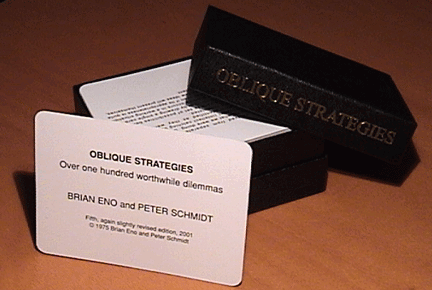
Oblique Strategies (subtitled over one hundred worthwhile dilemmas) is a set of published cards created by Brian Eno and Peter Schmidt. Now in its fifth edition, they were first published in 1975. Each card contains a phrase or cryptic remark which can be used to break a deadlock or dilemma situation.
:::A few examples:::
>State the problem in words as clearly as possible
>Only one element of each kind
>What would your closest friend do?
>What to increase? What to reduce?
::::From the introduction to the 2001 edition:::
These cards evolved from separate observations of the principles underlying what we were doing. Sometimes they were recognised in retrospect (intellect catching up with intuition), sometimes they were identified as they were happening, sometimes they were formulated.
They can be used as a pack, or by drawing a single card from the shuffled pack when a dilemma occurs in a working situation. In this case the card is trusted even if its appropriateness is quite unclear...
http://www.rtqe.net/ObliqueStrategies/
http://en.wikipedia.org/wiki/Oblique_Strategies
Ligna (Germany)

Ligna (Germany)
The free radio group LIGNA exists since 1995. LIGNA consists of the media theorists and radio artists Ole Frahm, Michael Hüners, and Torsten Michaelsen, who since the early nineties have been working at the "Freies Sender Kombinat" (FSK), a public non-profit radio station in Hamburg. In several shows and performances they have been investigating the importance of dispersal in radio as well as of the radio. One of the main focuses is to refer to forgotten and remote possibilities of radio use in order to develop new forms of interactive practices (Mental Radio Show ). Another emphasis has been placed on the development of concepts and the production of performative audio plays (Labyrinthe und Interferenzen), in order to find out how radio can intervene in public and controlled spaces, so that its public nature reappears in the form of uncontrollable situations (Radioballett: Übung in unnötigem Aufenthalt).
On the basis of these different models the borders of (left-wing) media theory, the "white cubed" art space, and political intervention are theoretically and practically examined.
A Radio Ballet is a radio play produced for the collective reception in certain public places. It gives the dispersed radio listeners the opportunity, to subvert the regulations of the space.
presentation
The Ligna presentation focuses on how radio can intervene in public and controlled spaces, so that its public nature reappears in the form of uncontrollable situations (Radioballett: Übung in unnötigem Aufenthal). Yet, Ligna's performances aim to confront the privatised, controlled production of capitalism with the dispersed, yet collective, uncanny and public production of the radio.
http://www.nomad-tv.net/under_ctrl/ligna.htm
Shilpa Gupta Biennial

Born 1976, Mumbai, Maharashtra, India
It’s possible these days to buy almost anything over the internet – but how about your own personalised religious blessing? That’s what web artist Shilpa Gupta made possible in her work blessed-bandwidth.net, characteristically using wit and irony to raise important questions about consumerism, spirituality and modern life. Gupta uses cutting-edge internet technology to explore fundamental human issues that affect all of us: the environment, globalisation, war, religion, human rights. Although she deals with serious issues, though, Gupta has a light touch; her work is always user-friendly and often humorous. For International 06, Gupta will look at the new possibilities opened up by media technology to two historical port cities: Liverpool and Mumbai.
Subscribe to:
Posts (Atom)
